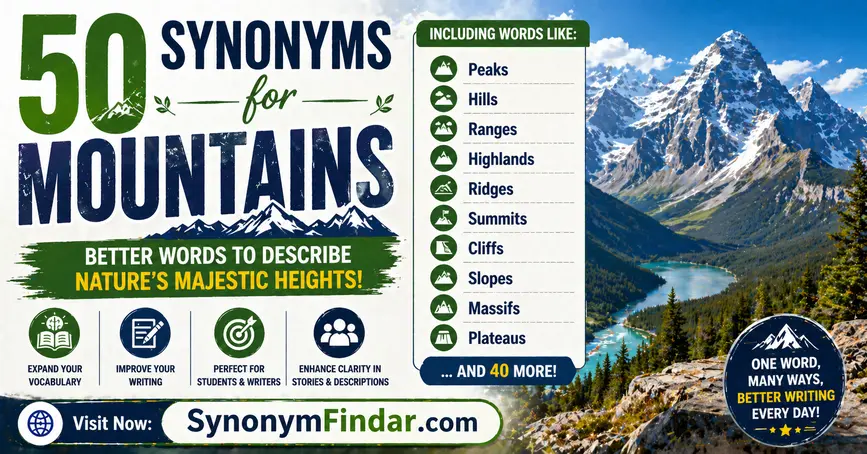
Quick answer: Synonyms for mountains include words like peaks, hills, ranges, ridges, and highlands—used to describe large natural elevations of land.
Have you ever written a sentence like, “The mountains were beautiful,” and then used the same word again and again? It quickly makes your writing feel repetitive. For example, in travel blogs or essays, repeating “mountains” reduces the impact of your description.
In simple words, mountains are large natural rises of land that stand high above the ground. Many writers search for synonyms for mountains to make their writing more vivid and engaging. If you are a student, blogger, or content writer, these words help you describe landscapes better. Even in daily English, using different words makes your communication more expressive and powerful.
Let’s explore 50 strong and useful synonyms you can start using today.
1. Peaks
Meaning: High points of mountains.
Examples:
- The peaks touched the sky.
- Snow covered the peaks.
2. Hills
Meaning: Smaller raised land areas.
Examples:
- The hills were green.
- We walked across hills.
3. Ranges
Meaning: Group of mountains.
Examples:
- The ranges stretched far.
- He climbed the ranges.
4. Highlands
Meaning: Elevated land area.
Examples:
- The highlands are cool.
- People live in highlands.
5. Ridges
Meaning: Long narrow mountain tops.
Examples:
- The ridges were sharp.
- He walked along ridges.
6. Summits
Meaning: Top of mountains.
Examples:
- The summit was snowy.
- They reached the summit.
7. Cliffs
Meaning: Steep rock faces.
Examples:
- The cliffs were tall.
- Waves hit the cliffs.
8. Slopes
Meaning: Side of mountains.
Examples:
- The slopes were steep.
- Trees grew on slopes.
9. Escarpments
Meaning: Steep slopes or cliffs.
Examples:
- The escarpments were rocky.
- He climbed escarpments.
10. Crags
Meaning: Rough rock peaks.
Examples:
- The crags looked sharp.
- Birds sat on crags.
11. Massifs
Meaning: Large mountain block.
Examples:
- The massif was huge.
- Snow covered the massif.
12. Alp
Meaning: High mountain.
Examples:
- The alp was cold.
- He climbed the alp.
13. Uplands
Meaning: High land area.
Examples:
- The uplands were quiet.
- Sheep grazed there.
14. Tablelands
Meaning: Flat high land.
Examples:
- The tablelands were wide.
- People farm there.
15. Plateaus
Meaning: Flat high land.
Examples:
- The plateau was large.
- They crossed plateau.
16. Bluffs
Meaning: High steep edges.
Examples:
- The bluff was tall.
- He stood on bluff.
17. Knolls
Meaning: Small hills.
Examples:
- The knoll was green.
- Kids played there.
18. Buttes
Meaning: Isolated steep hills.
Examples:
- The butte stood alone.
- He saw many buttes.
19. Pinnacles
Meaning: Tall pointed peaks.
Examples:
- The pinnacles were sharp.
- Clouds touched pinnacles.
20. Heights
Meaning: High areas.
Examples:
- The heights were cold.
- He climbed the heights.
21. Mounts
Meaning: Another word for mountains.
Examples:
- The mounts were high.
- He crossed many mounts.
22. Tors
Meaning: Rock hills.
Examples:
- The tor was rough.
- He climbed the tor.
23. Rises
Meaning: Elevated land.
Examples:
- The rises were soft.
- Grass grew there.
24. Rocky Heights
Meaning: High rocky areas.
Examples:
- The rocky heights were tough.
- He climbed them.
25. Snowcaps
Meaning: Snow-covered tops.
Examples:
- The snowcaps shined.
- They looked bright.
26. Alpine Heights
Meaning: High mountain areas.
Examples:
- Alpine heights are cold.
- He visited alpine heights.
27. Sierra
Meaning: Mountain range.
Examples:
- The sierra was long.
- He explored sierra.
28. Cordillera
Meaning: Chain of mountains.
Examples:
- The cordillera stretched far.
- He crossed cordillera.
29. Highland Peaks
Meaning: High mountain tops.
Examples:
- The peaks were cold.
- Snow covered them.
30. Summit Range
Meaning: Group of peaks.
Examples:
- The summit range was wide.
- He explored it.
31. Elevated Land
Meaning: Land above ground level.
Examples:
- The elevated land was cool.
- People settled there.
32. Mountain Tops
Meaning: Upper parts.
Examples:
- The mountain tops were white.
- Clouds covered them.
33. Hilltops
Meaning: Top of hills.
Examples:
- The hilltops were green.
- We rested there.
34. Skyline Peaks
Meaning: Peaks touching sky.
Examples:
- The skyline peaks were high.
- They looked amazing.
35. Crater Rims
Meaning: Edge of volcanic peaks.
Examples:
- The crater rim was wide.
- He walked around it.
36. Rock Formations
Meaning: Natural rock shapes.
Examples:
- The formations were huge.
- Tourists visited them.
37. Steep Heights
Meaning: High and steep areas.
Examples:
- The steep heights were hard.
- He climbed slowly.
38. Rocky Slopes
Meaning: Slanted rocky land.
Examples:
- The slopes were rough.
- He walked carefully.
39. Towering Peaks
Meaning: Very tall mountains.
Examples:
- The towering peaks amazed us.
- They stood high.
40. Mountain Chain
Meaning: Series of mountains.
Examples:
- The mountain chain was long.
- He crossed it.
41. Rugged Hills
Meaning: Rough hills.
Examples:
- The rugged hills were tough.
- He walked there.
42. Natural Heights
Meaning: High land by nature.
Examples:
- The natural heights were calm.
- Birds flew above.
43. Elevated Peaks
Meaning: High peaks.
Examples:
- The elevated peaks were cold.
- Snow covered them.
44. Sky-high Ridges
Meaning: Very tall ridges.
Examples:
- The ridges touched sky.
- He admired them.
45. Wild Highlands
Meaning: Untouched high land.
Examples:
- The wild highlands were free.
- Animals lived there.
46. Rocky Terrain
Meaning: Rough land area.
Examples:
- The terrain was tough.
- He crossed terrain.
47. Scenic Heights
Meaning: Beautiful high places.
Examples:
- The scenic heights were lovely.
- Tourists visited.
48. Elevated Terrain
Meaning: High land area.
Examples:
- The elevated terrain was cold.
- He walked there.
49. Hill Range
Meaning: Group of hills.
Examples:
- The hill range was green.
- We explored it.
50. Mountain Ridge
Meaning: Narrow mountain top.
Examples:
- The ridge was sharp.
- He stood there.
FAQs
1. What are mountains?
Mountains are high natural rises of land above the ground.
2. What is another word for mountains?
Words like peaks, ranges, and highlands are common.
3. Are hills the same as mountains?
No, hills are smaller than mountains.
4. What is a mountain range?
A group of connected mountains.
5. Why use synonyms for mountains?
They make writing more descriptive and engaging.
Conclusion
Learning synonyms for mountains helps you describe landscapes more clearly and avoid repetition. It improves your writing and makes your content more vivid. If you are writing stories, blogs, or travel content, using different words makes your language more powerful. Practice these synonyms daily to sound more confident and expressive.

Rana Fareed is an MPhil graduate in Business Administration and an LLB degree holder.
He is the author of the blogs on this website, providing accurate and easy-to-use synonyms to help readers improve their English vocabulary. Contact Author Rana Fareed